Speed close to the world record
: “Tending to be too fast” – so says Alain Schönmann from the Cantonal Police’s Road Safety Department, who leads the Akzent Forum’s e-bike course alongside Stephan Lingenhel from spontEbike.ch. His comparisons in the theory section of the course are impressive. For example, in 2005, racing cyclist Ondřej Sosenka set the world hour record in the time trial with a speed of 49.7 kilometres. You can travel at almost the same speed on an e-bike with a yellow number plate – the so-called S-pedelecs: 45 kilometres per hour. At this speed, you can even easily keep up with the peloton in the Tour de France; there, the cyclists pedal at an average of 42 kilometres per hour as they head towards the Champs-Élysées.
This high speed affects the braking distance: it is 13 metres when cycling at 20 kilometres per hour, rising to 37 metres at 45 kilometres per hour. It is therefore worth investing in an e-bike with high-quality brakes, maintaining constant awareness of the road ahead – and practising your braking skills. A high-visibility cycling helmet, bright clothing and lights are also a plus for other road users, helping them to better assess the speed of cyclists.
From braking training up to the Läuberen
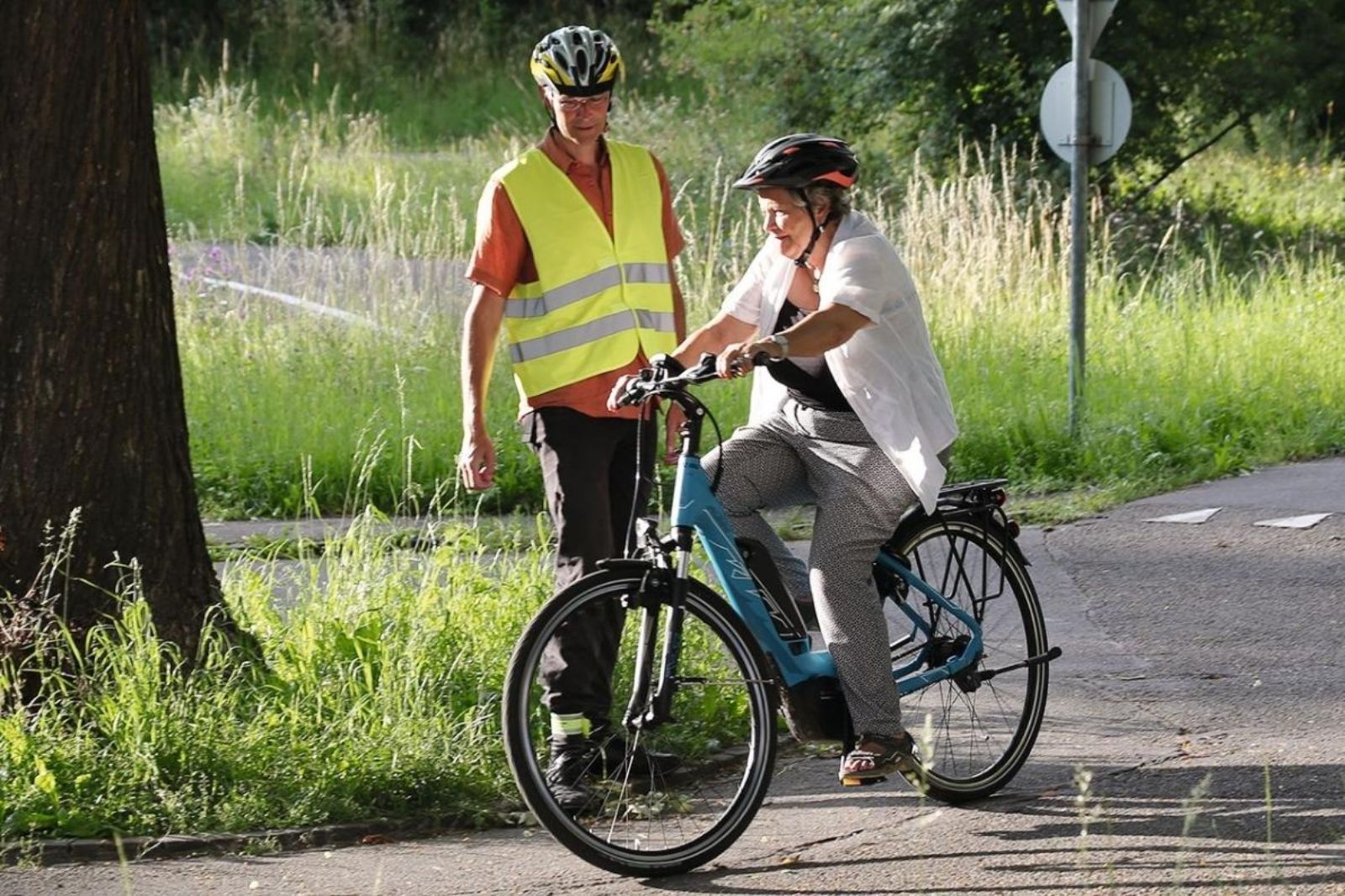
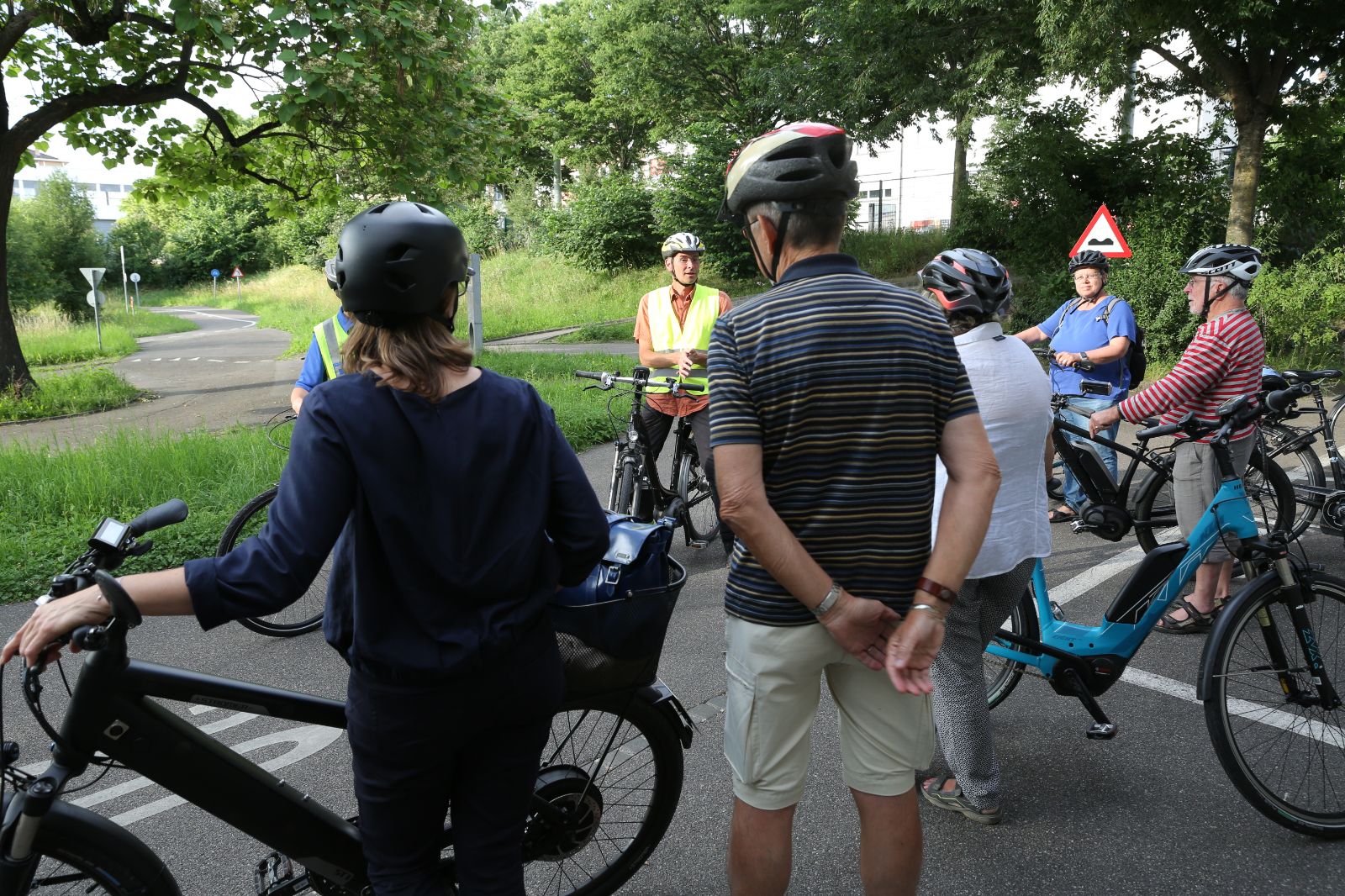
In the practical part of the course, the five participants therefore first practised powerful braking in the traffic training area on Wasgenring under the motto ‘Full on the brakes’. They also practised slalom riding before heading out on this lovely summer evening in mid-June to the Allschwil industrial estate and from there, via the village centre, up to the Läuberen. The sun was just setting on the horizon there. The sweeping view over the town, towards the Black Forest and the Vosges made up for the steep climb. A lovely way to round off an informative course. Or did you know that for an e-bike trip to Alsace, you need a motorbike helmet and a high-visibility vest, and that you’re not allowed to ride on cycle paths?